Since the Section 232 tariffs took effect, I've been receiving more questions from procurement teams. Most aren't asking about the policy itself—they've already read the announcements. The real question is:
"Do we need to change our sourcing strategy?"
In many cases, the answer is yes.
If your API supports a drug that is still protected by patent (for example, products listed in the FDA's Orange Book or Purple Book), the new tariffs can significantly increase your landed cost. For some imported APIs, additional trade measures may further increase the total duty burden depending on the country of origin and applicable regulations.
For generic, off-patent APIs, the situation is different. Products such as Gadobutrol and α-Lipoic Acid (ALA) are currently outside the Section 232 tariff scope. However, the exemption is subject to future review, and supplier qualification is never something you want to do under time pressure.
One trend I'm seeing is that more procurement teams are beginning to qualify secondary suppliers before they actually need them. API qualification, technical review, quality audits, and regulatory documentation can easily take several months. Waiting until a tariff change is announced is often too late.
Another point that's becoming increasingly important is documentation.
When tariffs substantially increase the value of a shipment, customs clearance becomes far more sensitive. COAs, batch documentation, DMF status, country-of-origin records, and shipping documentation are no longer routine compliance items—they can directly affect supply continuity.
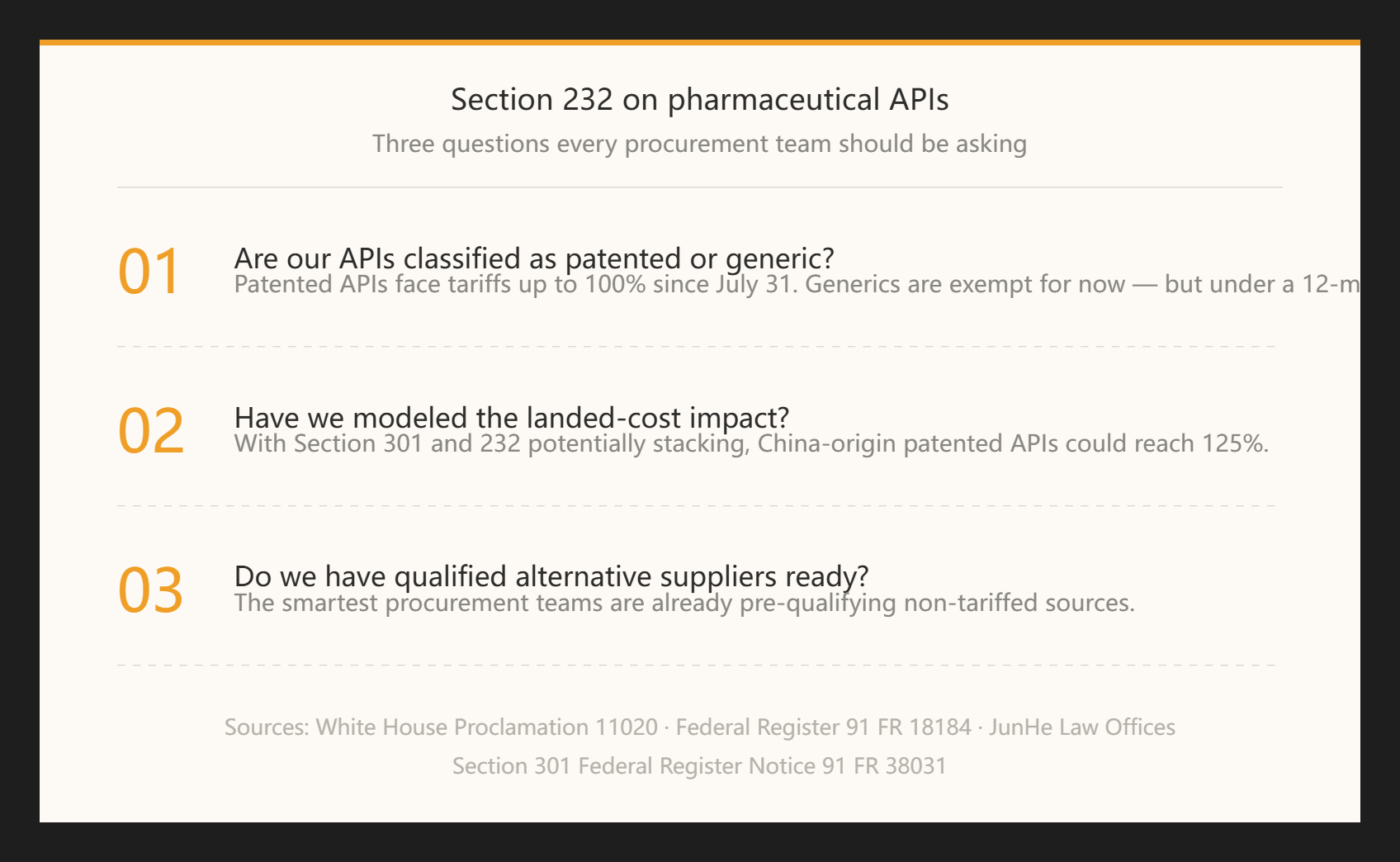
If I were reviewing my sourcing strategy today, I'd ask three questions:
✅ Are any of our APIs subject to the new Section 232 tariffs?
✅ Have we modeled the potential landed-cost impact under different tariff scenarios?
✅ Do we already have qualified alternative suppliers if the regulatory or tariff landscape changes?
The companies that prepare early usually have the most flexibility when policies evolve.
Sources: White House Proclamation 11020, White House Fact Sheet, Federal Register, China's Ministry of Commerce/Xinhua, and JunHe Law Offices.